Showing posts with label Origins. Show all posts

Tuesday, September 23, 2014

Jeans vs. Denim

First, just a quick logistical mention: As things have been uber-busy, we're temporarily going back to two posts a week, rather than three. However, we do have a ton of good stuff in the pipeline that has to get fit into the schedule, so this change may be short-lived (or flexible, at the very least)! Anyway, just wanted to keep y'all abreast of the goings-on round here. On to the article:

I'm admittedly a sucker for terminology, and as much as I love learning the definitions and origins of menswear nomenclature, it bugs the hell out of me when people (especially professionals) get it mixed up! Sure, in the big scope of things, it's not the end of the world, but as a personal pet peeve, I'll keep trying to shed light on the correct classifications as much as possible.

With that in mind, today I want to take a look at a common misnomer, and the distinction between 'denim' fabric and 'jeans' trousers.

Pretty regularly, the two terms are kind of jumbled together, when there is actually a pretty significant difference between the two - and it's not even that the terms aren't interchangeable. In fact, they refer to two completely different categories.

As I alluded to above, 'denim' refers to a fabric, while 'jeans' refers to a cut of pants.

Denim is merely a sturdy cotton twill fabric woven with (traditionally) indigo warp threads, and undyed, white weft threads that provide the signature color and fading of denim fabric. Beyond that, the fabric (and terminology) is not limited to pants at all, but can be applied to literally anything, from shirts to jackets to ties to even shoes, and even inside the 'pants' category, it can be used to make traditional 'jeans' or more formally cut trousers, or even the dreaded 'jorts'.

Denim, not jeans. Notice the fabric - and the fact that they aren't pants.
So what are 'jeans' then? Jeans are a very specific cut of pants, inherently casual, and yes, most commonly made out of denim. Originally, the term was used for work pants that were introduced by Levi Strauss in the 1800's. These pants were reinforced at 'stress points' with copper rivets, and were at first made with just three pockets. Over time, the design developed and two more pockets were added, for a total of five (two in the back, two at the hips, and coin pocket), thus the now-interchangeable term 'five-pocket pants (or jeans).' Like I said, these days jeans are most often made out of a denim fabric, but they were actually first made out of canvas, and today can be found in corduroy as well as other fabrics, usually more hefty and sturdy than more formal trouser materials.

Jeans, not denim. Notice the five-pocket styling and riveted seams, but canvas fabric.
So there you have it - not a life-changing distinction, but it never hurts to get it right!

Wednesday, April 30, 2014

Origins - Hacking Pockets

So, we've been coming at you with a lot of pretty lengthy posts, but this isn't college, we aren't here to give you loads of 'homework' and assigned reading, so let's take a quick break with a short post. It's been a while since we checked out a bit of menswear terminology, so today we'll take a look at the term 'hacking pockets.'

Hacking pockets is a term that refers to the positioning of the pockets on a suit jacket or blazer (rather than the actual pocket style, although I don't believe you will ever see this with patch pockets - just flaps and jetted). 

To understand the term when it comes to menswear, and why it's used, you have to understand the origin of the word. To 'hack' was once a British term (maybe still is?) for recreational horse-back riding. Therefore, you got it, hacking pockets referred to a style designed for equestrians.

A jacket with hacking pockets will have the pockets placed at a slant, rather than straight across. For riders, this served two purposes: first, it made it easier to reach into the pockets while horseback. Second, it helped keep things from falling out of the pockets while the men rode.

Straight Pockets....                                                                       ...and Hacking Pockets    
Photo Credit: Dragon Inside

Today, obviously, most people (even with hacking pockets) are not wearing their suits to ride horses, but the pockets are still in style. Largely, they are a throwback to a more casual, British, 'country' style jacket, but have become incorporated in day-to-day suiting to the extend that it's become mainly a matter of personal style preference. Some shorter men prefer these pockets as well, as they lend to a more vertical line through the suit, rather than chopping up one's height with horizontal lines a la straight pocket. Personally, I have some jackets with and some without, and don't have a strong preference either way. Regardless, informed decisions are the best decisions!


Now you know! Do you have a personal preference?

Friday, April 26, 2013

Origins (and more) - The Brogue Shoe


I can’t remember where I first read about the history of the brogue shoe, but I think it was one of the first sartorial history tidbits I picked up that really got me interested in the background behind the classics we see everyday. The brogue shoe, like many other aspects of style, originated for a purely functional purpose. The shoe was worn by farmers in the United Kingdom who would spent their days working in boggy and swampy fields inherent to the region. Wearing traditional shoes, these farmers would find themselves constantly pulling off their shoes to empty out the water from the swamps. The brogue was a simple solution to this squelchy problem. Shoemakers began to punch holes through the leather uppers of the shoes, usually following seams and running along the bottom of the shoe. These holes would allow the water to drain throughout the day. While feet still got wet, they weren’t soaking all day and provided a new level of functionality. These days, as the style has become more of a fashionable design rather than an operational advantage, the perforations no longer are punched the whole way through the shoe, so they wouldn’t help you much in a swamp, but they look damn good. I love a design that takes a standard, minimal design and adds a bit of flair without taking away from the class and grace of the item, and most of my favorite shoes have brogue detailing.


Some additional info:

There are actually a few standard ‘levels’ of brogue-ing (if that’s a word).
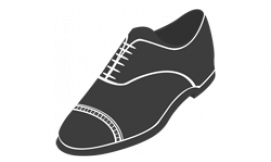
  • The ‘quarter-brogue’ shoe refers to a cap-toe shoe (usually an oxford) with brogue details running only along the seam of the cap. 


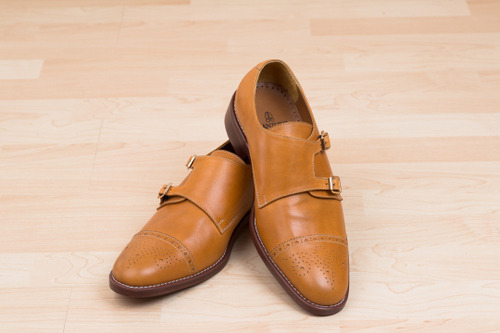
  • A half brogue is also a cap-toe shoe, but adds brogue details on the toe as well as the cap seam, and usually along the other seams inherent to an oxford style shoe as well. 

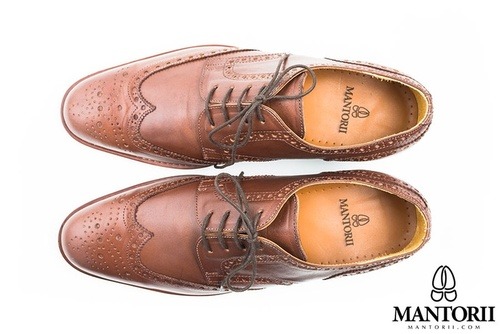
  • A wingtip or full brogue incorporates the extra seaming of a wingtip shoe, and lines those seams with brogue detailing for a much more intricate design. 

  • Less often, you will plain-toe shoes (no cap) with decorative brogue details. 


These pictures are all borrowed from the Mantorii Custom Footwear website. If you have the dough, I highly recommend checking them out. I myself haven’t had the influx of cash needed to snag a pair, but damn do those shoes look nice. They are also fully customizable, from leather type and color to general style of shoe or boot to brogue details, and are based off a personalized outline of your foot to ensure the highest level of fit and comfort. They aren’t cheap, but they are pretty comparable to a new pair of Allen Edmond’s. If any of you do make a Mantorii purchase, be sure to let me know how it turns out! I personally have my eyes set on the custom double-monk designed by Sabir M. Peele (author of Men’s Style Pro), which features half-brogue detailing: